

When you suffer a severe injury or illness because of someone else’s negligence, our Knoxville catastrophic injury lawyers can help you pursue compensation from the responsible party.


A catastrophic injury can change your life in an instant. A devastating car accident, semi-truck collision, motorcycle crash, construction accident, workplace incident, defective product, medical error, or other act of negligence in Knoxville can leave you facing permanent disability, years of medical treatment, lost income, and uncertainty about what the future holds.
At Poulin | Willey Trial Lawyers, our Knoxville catastrophic injury lawyers represent seriously injured people and families throughout Knoxville, Knox County, and East Tennessee. We understand that catastrophic injury cases are different from ordinary accident claims because the consequences may last for decades—or a lifetime.
These cases require attorneys who look beyond today’s hospital bills to understand what the injury could mean for your future medical care, earning capacity, independence, family, and quality of life.
Our approach combines Knoxville representation with the resources and support of a larger personal injury law firm.
If you or someone you love suffered a life-changing injury because of another person’s or company’s negligence, CALL Poulin | Willey Trial Lawyers
FREE CASE EVALUATION | AVAILABLE 24/7 | NO FEE UNLESS WE WIN

The financial stakes in a Knoxville catastrophic injury claim can be substantial, which gives insurance companies every reason to scrutinize the extent and long-term cost of your injuries. A settlement that appears significant today may fall far short if you need future surgeries, rehabilitation, home healthcare, assistive equipment, or decades of lost earnings. Our Knoxville catastrophic injury lawyers work to document the full impact of a life-changing injury before pursuing compensation from the responsible parties.
Catastrophic injuries can arise from car crashes, commercial truck accidents, motorcycle collisions, construction accidents, workplace incidents, dangerous properties, defective products, medical negligence, and other serious events throughout Knoxville and East Tennessee. We investigate how the injury occurred, identify potentially responsible parties, preserve critical evidence, and build a claim based on both your immediate losses and anticipated future needs.
Life-changing injuries require careful preparation and substantial resources. Depending on the case, our legal team can work with medical specialists, accident reconstruction professionals, engineers, vocational experts, economists, and life-care planners to establish how an injury occurred and what it may cost over the victim’s lifetime. We build catastrophic injury claims with the evidence needed to negotiate from a position of strength and prepare for litigation when necessary.
A catastrophic injury can already leave your family facing overwhelming medical expenses and lost income. You shouldn’t have to add upfront attorney fees to that burden. Poulin | Willey Trial Lawyers offers free case evaluations, and qualifying catastrophic injury cases are handled on a contingency-fee basis—meaning attorney fees are collected only if compensation is recovered. Call 800-777-7777 anytime, 24/7, to discuss your case.
In 2020, Injuries in Tennessee caused 8,224 deaths, 37, 437 hospitalizations and 469,180 emergency department visits. Each day in Tennessee there are approximately 22 deaths due to injuries, 98 hospitalizations for treatment of an injury, and 1,285 visits to an emergency room for an injury. Tennessee report 16,800 private-industry workplace injury and illness cases involving days away from work in 2025, while 155 fatal occupational injuries were recorded statewide. *https://www.tn.gov/health/injury.html
Many catastrophic injuries result from preventable conduct. A distracted driver, fatigued commercial truck operator, unsafe property condition, defective product, dangerous workplace, or medical error can leave another person dealing with permanent consequences. When negligence causes a catastrophic injury in Knoxville or East Tennessee, our attorneys investigate what happened and pursue accountability from the parties legally responsible.
A catastrophic injury claim must account for far more than the bills accumulated immediately after an accident. Depending on the circumstances and Tennessee law, compensation may include past and future medical expenses, lost income, diminished earning capacity, pain and suffering, permanent disability, disfigurement, rehabilitation, assistive technology, home or vehicle modifications, and long-term care needs. Our Knoxville catastrophic injury lawyers work to identify and document the losses applicable to each individual case.
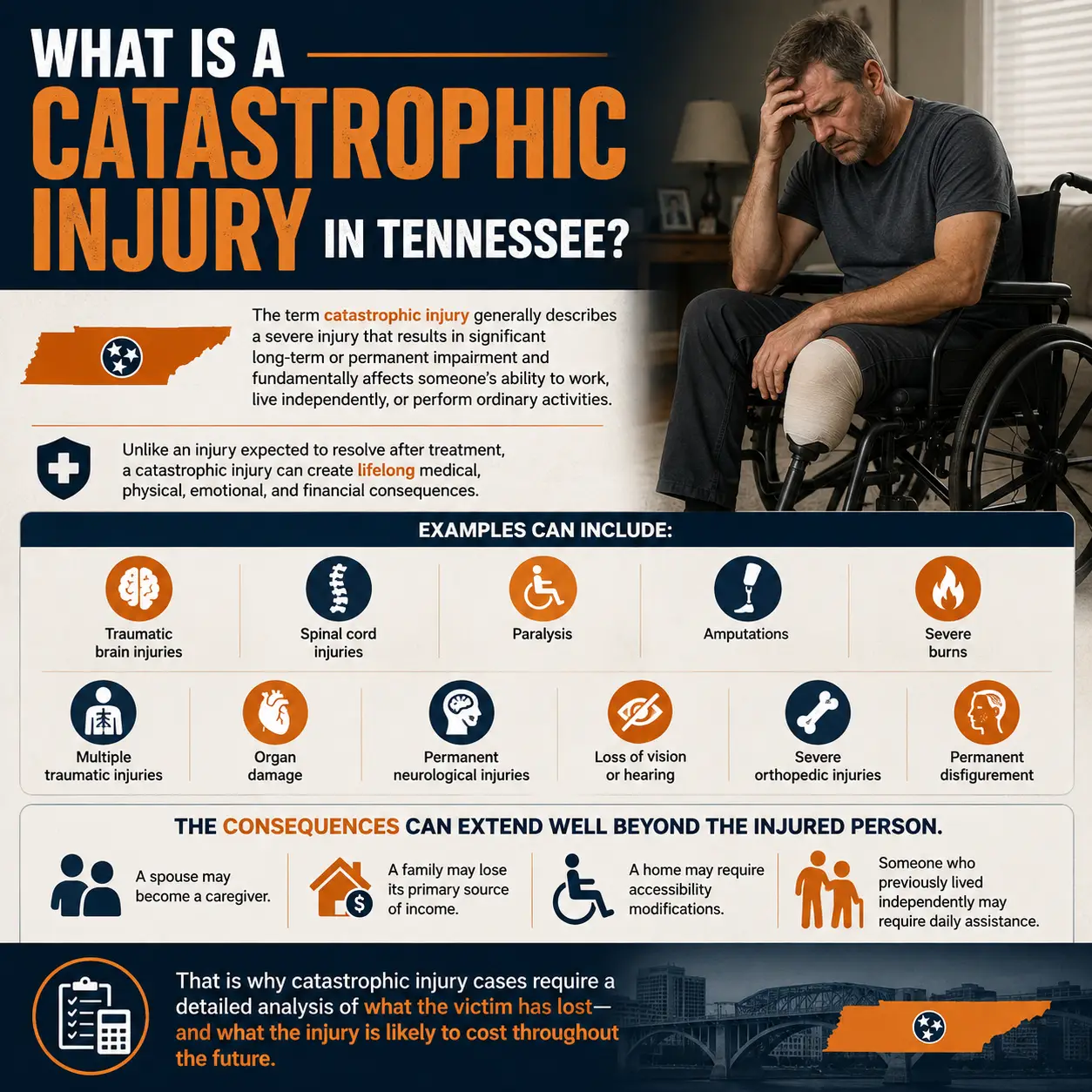
The term catastrophic injury generally describes a severe injury that results in significant long-term or permanent impairment and fundamentally affects someone’s ability to work, live independently, or perform ordinary activities.
Unlike an injury expected to resolve after treatment, a catastrophic injury can create lifelong medical, physical, emotional, and financial consequences.
Examples can include:
Traumatic brain injuries • Spinal cord injuries • Paralysis • Amputations • Severe burns • Multiple traumatic injuries • Organ damage • Permanent neurological injuries • Loss of vision or hearing • Severe orthopedic injuries • Permanent disfigurement
The consequences can extend well beyond the injured person.
A spouse may become a caregiver. A family may lose its primary source of income. A home may require accessibility modifications. Someone who previously lived independently may require daily assistance.
That is why catastrophic injury cases require a detailed analysis of what the victim has lost—and what the injury is likely to cost throughout the future.
A severe traumatic brain injury (TBI) can affect memory, reasoning, speech, concentration, behavior, mobility, and the ability to live independently. Our Knoxville brain injury and catastrophic injury lawyers investigate how the trauma occurred and pursue compensation that accounts for medical treatment, rehabilitation, lost earning capacity, and potential lifelong care.
Damage to the spinal cord can result in paraplegia, quadriplegia, loss of sensation, chronic pain, impaired organ function, and permanent loss of mobility. Knoxville spinal cord injury victims may require specialized medical treatment, wheelchairs, accessible transportation, home modifications, personal assistance, and ongoing rehabilitation throughout their lives.
Serious burns caused by vehicle fires, explosions, electrical accidents, defective products, workplace incidents, or chemical exposure can require repeated surgeries, skin grafts, reconstructive procedures, and extensive rehabilitation. Our Knoxville catastrophic injury lawyers pursue claims involving the physical, financial, and emotional consequences of severe burn injuries.
The traumatic loss of an arm, leg, hand, foot, finger, or other body part can permanently affect a person’s independence and ability to work. An amputation claim may involve substantial future costs for prosthetics, replacement devices, rehabilitation, occupational therapy, home modifications, and diminished earning capacity.
Some fractures go far beyond an ordinary broken bone. Crushed limbs, complex fractures, pelvic injuries, joint destruction, and multiple orthopedic injuries can require numerous surgeries and leave victims with permanent mobility limitations and chronic pain. These injuries frequently arise from high-impact crashes, construction accidents, industrial incidents, and falls.
Severe burns, lacerations, facial trauma, surgical complications, and other injuries can cause permanent scarring or disfigurement. Beyond physical discomfort and additional treatment, these injuries can profoundly affect a person’s confidence, emotional well-being, relationships, employment, and overall quality of life.
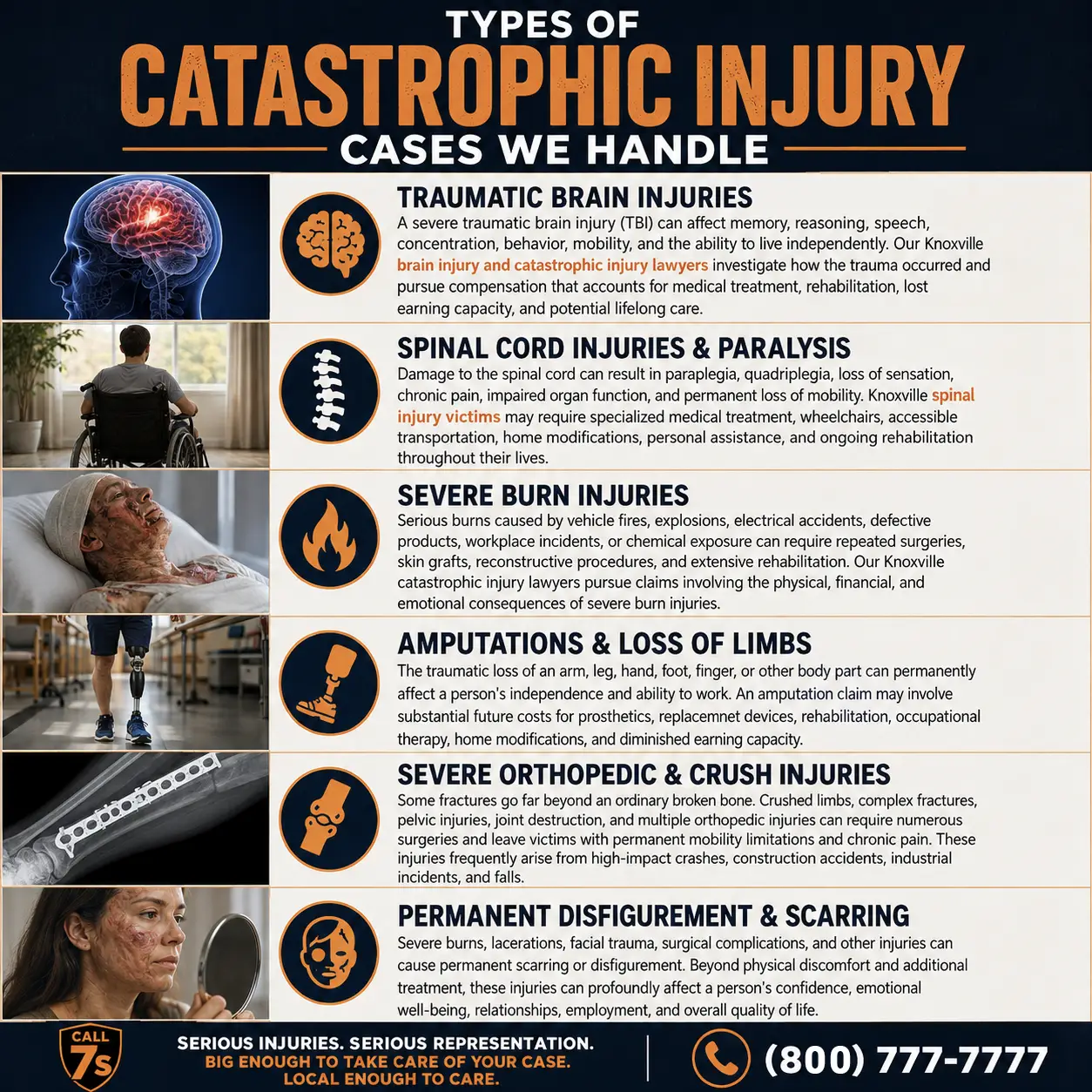
Damage to the brain, spinal cord, or peripheral nervous system can result in loss of motor control, chronic nerve pain, cognitive impairment, tremors, seizures, sensory loss, or other permanent neurological problems. These cases often require extensive medical documentation and expert analysis to understand the victim’s long-term prognosis.
Some catastrophic accidents cause several devastating injuries simultaneously. A high-speed Knoxville car or truck crash, for example, might produce brain trauma, fractures, internal injuries, nerve damage, and permanent mobility problems. Our attorneys evaluate the combined lifetime impact of multiple injuries, rather than treating each diagnosis as an isolated medical problem.

When your life has been permanently changed, your lawyer shouldn’t feel like someone sitting in a distant call center hundreds of miles away.
A Knoxville catastrophic injury lawyer understands the community where you live, work, receive medical treatment, and rebuild your life.
Depending on the circumstances, evidence and witnesses may be located throughout Knoxville, Knox County, and surrounding East Tennessee communities. Your treatment may involve Knoxville-area hospitals, physicians, rehabilitation providers, therapists, and specialists.
Local representation provides another important advantage:
You should be able to communicate with people who understand your case and recognize that behind every catastrophic injury claim is a real person and family dealing with extraordinary circumstances.
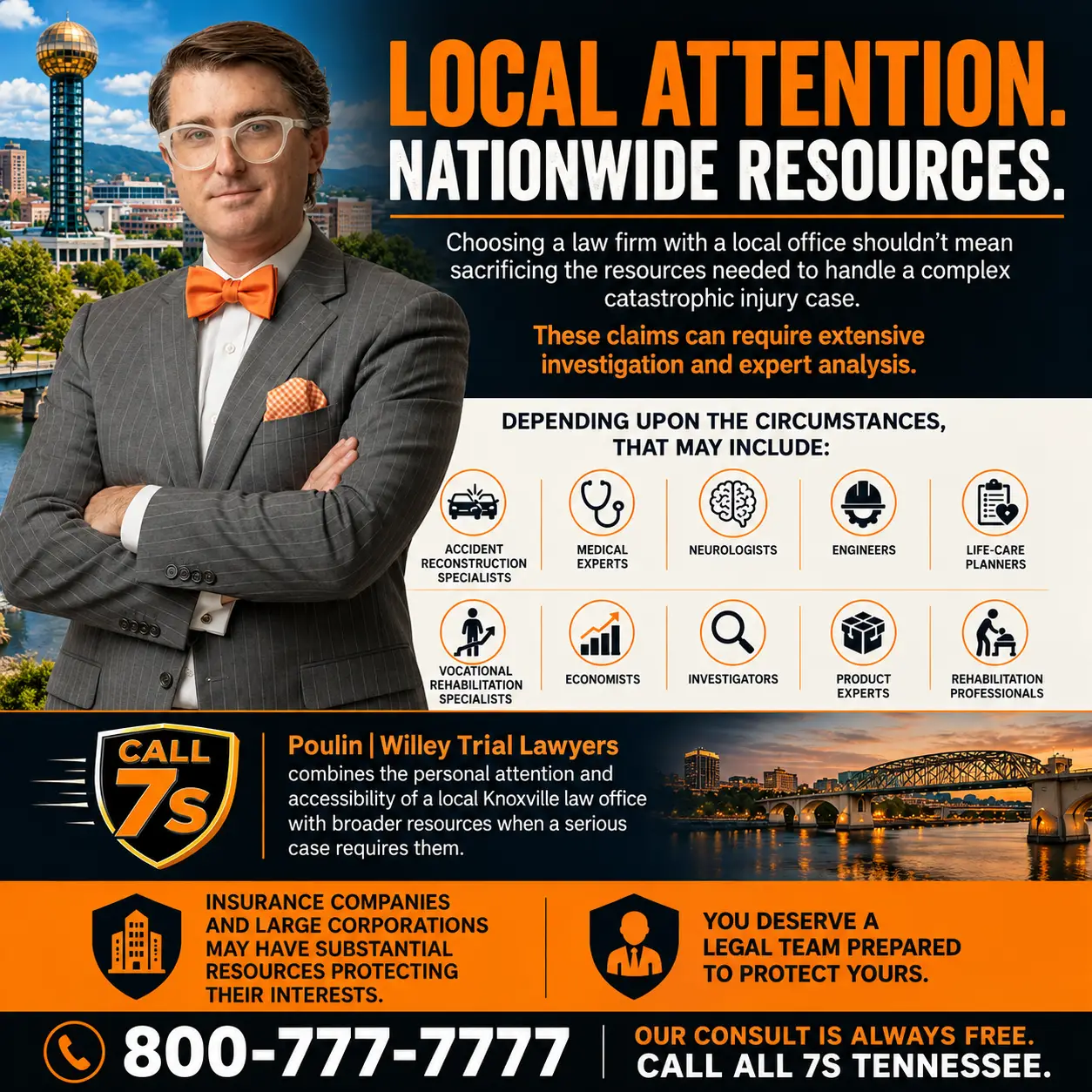
Choosing a law firm with a local office shouldn’t mean sacrificing the resources needed to handle a complex catastrophic injury case.
These claims can require extensive investigation and expert analysis.
Depending upon the circumstances, that may include:
Accident reconstruction specialists • Medical experts • Neurologists • Engineers • Life-care planners • Vocational rehabilitation specialists • Economists • Investigators • Product experts • Rehabilitation professionals
Poulin | Willey Trial Lawyers combines the personal attention and accessibility of local Knoxville law office with broader resources when a serious case requires them.
Insurance companies and large corporations may have substantial resources protecting their interests.
You deserve a legal team prepared to protect yours.
There are plenty of personal injury firms advertising to seriously injured people in Knoxville.
We believe catastrophic injury victims deserve something different:
Local Knoxville Representation: We have an office right here in this community for you.
Resources for Complex Cases: When appropriate, we can work with investigators, medical professionals, engineers, reconstruction specialists, economists, vocational experts, and life-care planners.
Personalized Attention: You’re a person—not a catastrophic injury case number. We want to understand how the injury has changed your health, work, family, independence, and future.
Evidence-Driven Investigation: Serious cases require serious preparation. We investigate liability, causation, damages, and the long-term consequences of the injury.
Trial-Ready Representation: Many claims resolve through settlement, but a serious injury case should be prepared with litigation in mind when necessary.
24/7 Availability: Catastrophic accidents don’t happen on a schedule. You can contact us 24 hours a day, seven days a week.
Free Case Evaluation: It costs nothing to tell us what happened and discuss whether your circumstances may support a catastrophic injury claim.
There is no legitimate one-size-fits-all answer. Potential value depends on liability, available insurance or other sources of recovery, injury severity, medical expenses, future treatment, permanent impairment, lost earnings, future earning capacity, pain and suffering, and other damages available under Tennessee law.
The damages can extend decades into the future. Determining future medical costs, lost earning capacity, disability, rehabilitation requirements, and long-term care may require substantial medical, financial, and vocational evidence.
Before accepting a settlement after a life-changing injury, it is important to understand both your current and reasonably anticipated future losses. A settlement generally resolves the claim permanently, so consider having an attorney evaluate the offer and the scope of your damages before signing a release.
Deadlines depend on the type of claim and circumstances, and Tennessee can impose relatively short filing periods for some personal injury actions. Exceptions and different rules can apply, so speak with an attorney promptly rather than assuming a particular deadline applies.
You may have potential workers’ compensation rights, and in some situations you could also have a separate claim against a negligent third party that contributed to the accident. These claims involve different rules and should be evaluated individually.
Unlike major natural disasters, which are relatively rare, catastrophes are quite common. School bus crashes, helicopter crashes, falling construction debris, shootings, and other catastrophic incidents occur so often that we may be desensitized to them—until they happen to us or somebody we care about.
When tragedy strikes on a large scale, whether it’s a bridge collapse, a train derailment, or a deadly fire, many people are quick to call it an “accident.” But the truth is, many catastrophic events are preventable.
Here are some of the most common, and often preventable, causes of catastrophic events:
Bridges, roads, parking garages, dams, and buildings all require ongoing inspections and upkeep to remain safe. When governments, property owners, or corporations fail to maintain infrastructure, the results can be devastating.
Deferred maintenance on bridges can lead to structural failures and sudden collapse, and aging pipelines or electrical systems that go unrepaired can spark fires or explosions.
In many cases, warning signs, like visible cracks, rust, or past inspection failures, are ignored until it’s too late.
Planes, trains, and commercial trucks operate within complex systems where a single mistake can result in mass casualties.
Operator fatigue or distraction, especially in trucking and rail industries, can cause catastrophic collisions. Failure to follow safety protocols or miscommunication between controllers and operators can also lead to disasters.
With proper training, oversight, and technology safeguards, many transportation-related tragedies could be avoided.
While natural disasters like hurricanes and wildfires can’t be stopped, the level of damage they cause often depends on how well communities are prepared.
Lack of evacuation plans, early warning systems, or storm-resistant infrastructure can turn a manageable crisis into a mass casualty event. Additionally, failure to secure hazardous materials during a natural disaster can lead to secondary disasters like chemical spills or fires.
From high-rise buildings to residential homes, construction that fails to meet safety standards is a ticking time bomb.
Substandard materials, shortcuts during building, or ignoring building codes can lead to collapses and falling debris. Improper installation of heavy equipment like cranes or balconies can also result in sudden structural failures.
Developers and contractors have a legal and ethical responsibility to build safely and follow regulations, but all too often, cost-cutting takes precedence over safety.
In many industries, catastrophic events stem from profit-driven decisions that put lives at risk.
Failing to invest in safety systems or proper employee training to cut costs and ignoring known risks to avoid liability or delays in production are common ways that cheap businesses put others at risk.
Cutting corners might save money in the short term, but it can cost lives in the long run.
Regulations are in place to protect the public, but when agencies fail to enforce them, or look the other way, disasters can follow.
Infrequent inspections, weak penalties, and industry lobbying can result in unsafe conditions being allowed to persist.
Experiencing a catastrophic event can be overwhelming and disorienting. In those moments, it can be difficult to know what steps to take next.
Here’s a step-by-step guide on what to do if you find yourself in the aftermath of a catastrophic event in Tennessee.
Your health and safety are the most important. Get to a safe location as quickly as possible, and check for injuries on yourself and others nearby. Call 911 immediately if emergency medical help is needed.
Even if injuries seem minor, it’s crucial to get checked out by a medical professional. Some injuries, especially head, neck, or internal injuries, might not be immediately obvious.
If you’re physically able and it’s safe, start gathering evidence.
Take photos or videos of the scene, including damage, injuries, and contributing factors (structural damage, road conditions, or fallen objects), and write down or record your recollection of what happened while details are still fresh.
If possible, get names and contact info of any witnesses nearby. This documentation can be essential in determining liability and supporting your claim.
Notify the proper authorities and agencies. File a police report or official incident report if one hasn’t already been taken. If the event involved a business, property, or workplace, notify the site manager or HR department. For natural disasters or infrastructure failures, contact your local emergency management office or utility providers.
To begin the recovery process, file a claim with your homeowners, renters, health, auto, or life insurance, whichever is relevant to the incident. Document all communication with insurers and keep copies of your claim numbers, adjuster info, and submitted documents.
Remember, insurance companies may try to minimize your payout. You don’t have to accept their first offer, especially without legal guidance.
Start building a paper trail and save receipts for medical care, temporary lodging, vehicle rentals, or repairs. Keep track of lost income or work days.
If the catastrophic event was caused by negligence, unsafe conditions, or corporate or government oversight failures, you may be entitled to compensation.
Don’t sign anything from an insurer, company, or responsible party until you speak with a lawyer. A personal injury or catastrophic event attorney at CallSevensTennessee.com can help determine who is liable for your accident, what damages can be claimed, and how much compensation you deserve.
At CallSevensTennessee.com, we have the resources, experience, and dedication to take on major corporations, government entities, and insurance companies—and win. We never settle for less than you deserve.
For survivors of catastrophic events, the physical and emotional injuries can be life-altering and, in some cases, permanent.
Here are some of the most common injuries associated with catastrophic events:
Burn injuries are especially common in situations involving explosions, fires, or chemical spills, such as those seen in:
Burns can range from first-degree to life-threatening third-degree injuries, often requiring intensive care, skin grafts, long-term rehabilitation, and reconstructive surgery. Burn victims may also experience lasting physical and emotional scars, chronic pain, and restricted mobility.
A violent blow to the head—common in building collapses, vehicle collisions, or falling debris—can cause a traumatic brain injury. TBIs can range from mild concussions to severe brain damage.
Common causes of TBIs in catastrophic events include:
Symptoms may include memory loss, confusion, seizures, speech issues, personality changes, and long-term cognitive impairment. In the most severe cases, TBIs can lead to permanent disability or require lifelong care.
In high-impact accidents, such as vehicle pileups, building collapses, or crane failures, spinal cord damage is a frequent and often devastating result.
Spinal injuries may cause partial or full paralysis, chronic pain, or loss of sensation and motor function. Many victims require wheelchairs, physical therapy, home modifications, and ongoing medical support for the rest of their lives.
These injuries not only affect physical ability but also have profound emotional, financial, and psychological consequences.
Victims caught under rubble, pinned during collisions, or hit by heavy objects may suffer:
Severe fractures can require surgical intervention, the installation of metal rods or pins, and lengthy periods of immobility and rehabilitation.
These are often not visible immediately but can be life-threatening without prompt treatment.
Blunt force trauma from impact or debris may damage internal organs such as the liver, kidneys, lungs, or spleen. Internal bleeding may go undetected without proper medical evaluation and imaging.
Such injuries are commonly seen in high-speed transportation accidents and structural collapses.
Some catastrophic events, such as those involving industrial machinery, large vehicle accidents, or explosions, may result in traumatic or surgical amputations of limbs.
Amputation can bring lifelong challenges in mobility, self-care, employment, and mental health. Prosthetics and rehabilitation are costly, and emotional support is essential for recovery.
Not all injuries are visible. Survivors of catastrophic events often suffer from serious psychological effects, including:
Mental health support is crucial after trauma, and emotional injuries are just as real as physical ones. Psychological damage can affect your relationships, your ability to work, and your overall quality of life.
In the most tragic cases, catastrophic events result in fatalities, leaving families to face unimaginable loss and long-term hardship. Surviving spouses, children, and parents may be entitled to compensation through a wrongful death claim, including:
CallSevensTennessee.com fights for families seeking justice after a preventable tragedy claims a loved one’s life.
When disaster strikes, victims often turn to their insurance companies for help. After all, that’s what insurance is for, right? Unfortunately, the reality is often much more complicated. At CallSevensTennessee.com, we’ve seen firsthand how policyholders can be blindsided not just by the event itself, but by the frustrating and unfair tactics insurance companies use to avoid paying out full and fair claims.
Here are some of the most common insurance issues that arise after catastrophic events, and what you can do to protect your rights.
One of the most painful scenarios occurs when an insurance company flat-out denies a claim that should be covered. Common reasons for denial include:
In the aftermath of a catastrophic event, these delays or denials can be devastating, especially when you need immediate help for medical bills, home repairs, or lost income.
Even when claims are approved, insurance companies may offer settlements that are far below what the damages actually cost to fix or recover from. Examples include:
Victims may feel pressured to accept these offers out of desperation, not realizing they’re entitled to more.
Following major accidents or events involving multiple parties, such as highway pileups, building collapses, or industrial explosions, insurers may dispute:
These disputes can drag on for months or even years, often while victims are suffering financially, emotionally, and physically.
In some cases, insurance companies act in bad faith, which means they knowingly delay, deny, or underpay a legitimate claim. Examples include:
If your insurer is acting in bad faith, you may have grounds for a lawsuit seeking damages beyond the value of your initial claim.